Photo: Studio publicity still for Humoresque (1946), Public Domain, via Wikimedia Commons
JOAN CRAWFORD
"Hollywood's Last Word in Glamour"
The Star Who Was Never Off Duty
She was born Lucille LeSueur in San Antonio, grew up poor in Lawton, Oklahoma, worked for her keep at a Kansas City convent school, and danced in Detroit chorus lines before a Shubert revue carried her to Broadway. By the time MGM renamed her Joan Crawford in 1925, she had decided something that would hold for the next fifty years: the shopgirl from Texas was gone, and in her place stood an immaculate, self-made movie star who would never again be caught looking like anything less.
What follows is Joan's travel story, from Los Angeles to the Belgian Congo, told through the hotels she checked into, the restaurants she held court in, and the ski resorts, beach clubs and grand suites she loved. Here's how to travel in the footsteps of the incomparable Joan Crawford.
""I never go outside unless I look like Joan Crawford the movie star. If you want to see the girl next door, go next door." - Joan Crawford
The Trail
Where to walk in their footsteps
California
Joan's America ran on a private railway of grand hotels. She kept homes in Beverly Hills, Brentwood and finally a Fifth Avenue penthouse, but her real addresses were the lobbies, the supper clubs and the studio commissaries where she could be seen being Joan. California is where the whole story started.
The Washington Hotel (now Palihotel Culver City)
When twenty-year-old Lucille LeSueur stepped off the train from Kansas City in January 1925 to dance for MGM, this modest boarding hotel on Van Buren Place, a few blocks from the studio lot, was her very first California address. She spent roughly her first six months here, before Joan Crawford existed. The 1920s building has been lovingly restored as the boutique Palihotel Culver City, which means you can now book the room where the whole story started.
3927 Van Buren Place, Culver City. Rooms from around $285 per night.
TCL Chinese Theatre (Grauman's)
On September 14, 1929, three months married to Douglas Fairbanks Jr. and newly declared "a star" by an MGM accountant, Joan pressed her hands and feet into the wet cement of the forecourt beside Pickford, Chaplin and Swanson. She had arrived in Hollywood four years earlier as an uncredited body-double for Norma Shearer. The prints are still there, and so is the sense of occasion.
Hollywood Boulevard. Forecourt free to visit; screenings and tours ticketed.
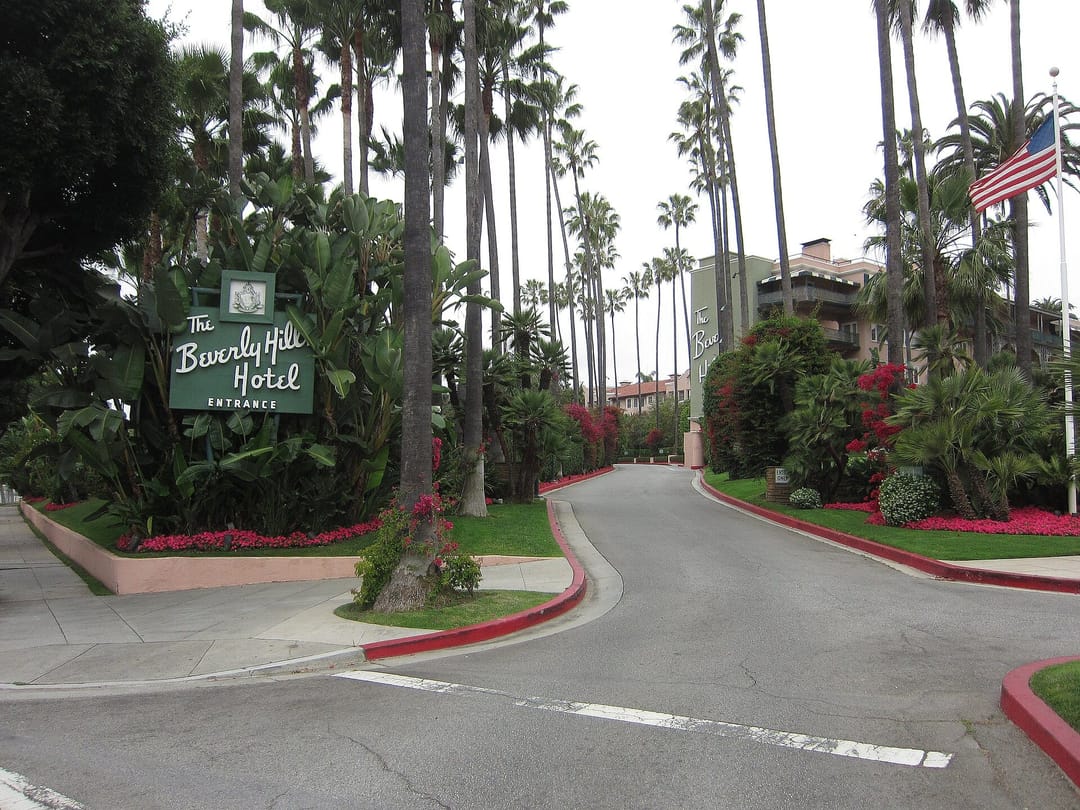
The Beverly Hills Hotel
The pink palace was Joan's natural habitat for premieres, awards dinners and feuds. She attended the Photoplay awards here (and was famously incensed by a low-cut Marilyn Monroe entrance) and turned up for a 1951 party honouring Dinah Shore. The Polo Lounge still rewards the sort of guest who dresses for lunch, which is to say the sort of guest Joan always was.
Beverly Hills. Rooms from around $800 per night.
The Beverly Wilshire
In October 1949, Joan and her lawyer Greg Bautzer attended a party here thrown by Louis B. Mayer for Prince Bernhard of the Netherlands. Bautzer danced with Ginger Rogers; on the drive home Joan asked him to step out and check a tyre, then drove off and left him to walk. The hotel is more forgiving of its guests than Joan was of hers.
Corner of Wilshire and Rodeo, Beverly Hills. Rooms from around $700 per night.
Musso & Frank Grill
The one great survivor. Joan's Hollywood was a city of supper clubs (Ciro's, the Mocambo, Romanoff's, the Cocoanut Grove) and every one of them is now gone. Musso's is the exception: it has poured martinis since 1919 and looked much the same through all of Joan's decades. When you want to dine where the old town still breathes, this is the room. Order a martini straight up and settle into a red flannel booth.
Hollywood Boulevard. Mains from around $30.
La Quinta Resort & Club
In the spring of 1946, the week after she won her Oscar, Joan let attorney Greg Bautzer follow her out to the desert, and the pair got together for the first time at La Quinta. The hacienda-style resort where Frank Capra wrote screenplays under the palms is still there, still low-slung and bougainvillea-draped, and still the right place to disappear for a scandalous long weekend.
La Quinta, near Palm Springs. Rooms from around $400 per night.
Carmel-by-the-Sea
For all the caviar and penthouses, Joan's happiest travelling ritual was startlingly simple. She loved to pack a picnic. Biographer Scott Eyman records that she would drive the twins up the coast to Carmel and lay out a hamper on the sand; her daughter Cathy remembered these as some of the warmest hours of her childhood. Do as Joan did: pack a proper hamper, drive Highway 1, and spread a rug where the cypress meets the Pacific.
Carmel-by-the-Sea, California. Beaches free; pack your own hamper.
The Hollywood Museum
Inside the old Max Factor Building, the Hollywood Museum keeps costumes, letters and personal effects from Joan and her contemporaries. It is the single best place to stand a few feet from the actual armour (the gowns, the shoulder pads, that face) from which Joan built her public self.
Highland Avenue, Hollywood. General admission around $18.
New York
New York bookends the story. A Shubert revue carried the young Lucille LeSueur to Broadway in the early 1920s, and after she married Alfred Steele in 1955 a Fifth Avenue penthouse overlooking Central Park became Joan's true home for the rest of her life.
The Algonquin Hotel
On June 3, 1929, Joan married Douglas Fairbanks Jr. at St. Malachy's church and the newlyweds stayed at the Algonquin. She was twenty-three, he was nineteen, and their union made her a sort of Hollywood crown princess, ushered at last into Pickfair. The Round Table hotel is still the literary heart of Midtown, still dark-panelled and clubby, and still a fine place to begin a marriage or a manuscript.
West 44th Street, New York. Rooms from around $350 per night.
2 East 70th Street
After she married Alfred Steele, the couple bought and gutted the top two floors of this Fifth Avenue building overlooking Central Park, and her old friend, the decorator Billy Haines, turned it into one of the most photographed apartments in New York. It became Joan's true home for the rest of her life. You cannot go in (it is private), but the façade at 70th and Fifth is a fine stop on a Central Park walk.
Fifth Avenue at East 70th Street, New York. Private residence; admire from the street.
George Eastman Museum, Rochester
This is where you can meet Joan off duty. The Eastman Museum holds and has preserved her own home movies, the 16mm footage she shot herself around 1940 to 1942, filming her family often in colour at a time when her features were still black and white. A gift from her grandson Casey LaLonde, they show the larger-than-life star unadorned, simply being herself. The museum also screens classic Hollywood in its Dryden Theatre the way it was meant to be seen, on film, in a proper house, so you can watch Mildred Pierce or Grand Hotel on a pilgrimage rather than a phone.
Rochester, New York. Admission around $18.
New York Public Library, Billy Rose Theatre Division
The Billy Rose Theatre Division at Lincoln Center is where Joan's paper trail lives: photographs, clippings, programmes and the documentary residue of a fifty-year career. Serious devotees can request materials in the reading room. It is also a short walk from the Plaza and the old Stork Club site, which makes for a tidy Crawford afternoon.
Lincoln Center, New York. Free; reading-room access by registration.
Elsewhere in North America
Beyond the two coasts, Joan's American map runs from a 2am Las Vegas elopement to Miami Beach winters as Pepsi's first lady, and back to the Oklahoma frontier town where young "Billie" Cassin grew up long before Hollywood remade her.
Flamingo Las Vegas
Las Vegas gave Joan her most dramatic wedding. At 2am on May 10, 1955, she married Pepsi chairman Alfred Steele in the penthouse of the Flamingo, days after he had talked her into eloping. Three weeks earlier she had served as hostess for the grand opening of the Riviera (with Liberace headlining), a hotel since demolished. Bugsy Siegel's Flamingo, much rebuilt, still anchors the Strip and still trades on exactly the midnight glamour Joan married into.
Las Vegas Strip. Rooms from around $100 per night.
Fontainebleau Miami Beach
Joan came to the Fontainebleau regularly through her Pepsi years, when Miami was the winter capital of American showbusiness and Morris Lapidus's curved white ziggurat was its throne room. It was where she could be a Pepsi ambassador by day and a movie star by night without changing hotels. The restored Fontainebleau still trades on that exact combination of boardroom and ballroom.
Miami Beach, Florida. Rooms from around $500 per night.
Museum of the Great Plains, Lawton, Oklahoma
Joan spent her childhood as "Billie" Cassin in Lawton, where her stepfather ran an opera house and she cut her foot so badly on a broken milk bottle that she missed a year and a half of school. The Museum of the Great Plains tells the story of the frontier town that made her, long before Hollywood remade her. A moving stop for the completist who wants to meet Lucille before she met the camera.
Lawton, Oklahoma. Admission around $8.
The Caribbean
Joan discovered the warm-weather resort circuit through Alfred Steele and Pepsi, and took to it instantly. The Caribbean was where the movie star could finally sit still, provided someone was there to photograph her sitting still.
Half Moon, Montego Bay
Joan spent several Christmases in the early 1960s at the historic Half Moon on Jamaica's north coast, having first come with Alfred Steele in the 1950s. The couple were especially fond of the resort's oceanfront cottages. Half Moon remains one of the Caribbean's grand old estates, all crescent beach and colonial calm, and its cottages still suit a movie star who wants the sea to herself.
Montego Bay, Jamaica. Rooms from around $500 per night.
Hotel Nacional de Cuba, Havana
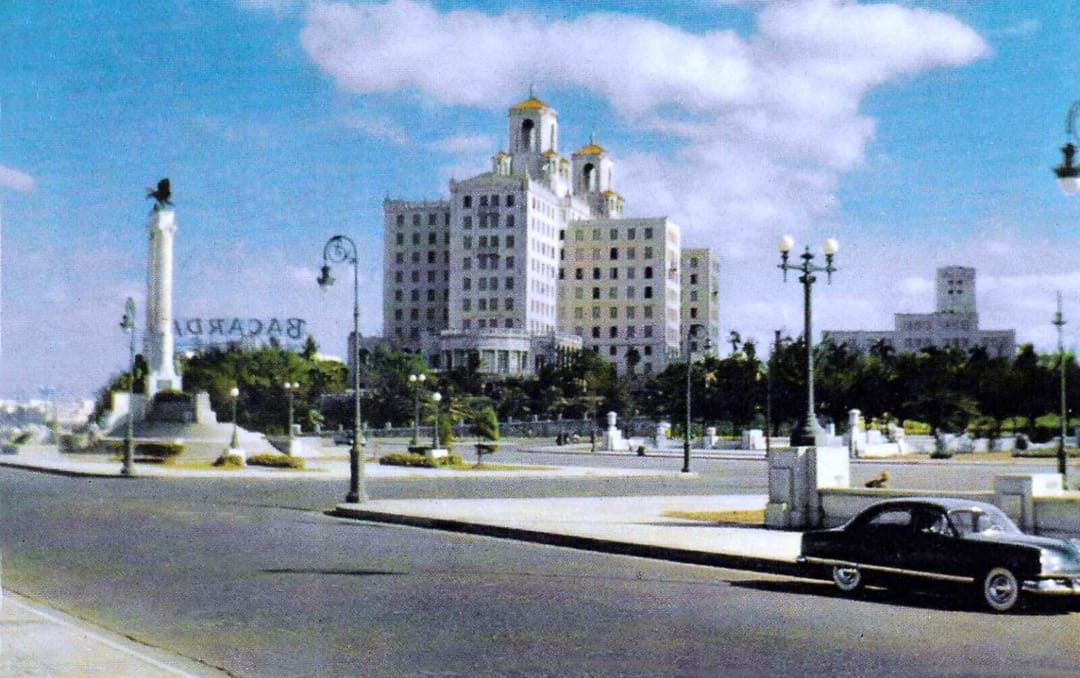
On her honeymoon with Alfred Steele, Joan took in pre-revolution Havana at its glittering height, staying at the iconic clifftop Hotel Nacional and dancing at the fabled Tropicana nightclub. The Nacional still presides over the Malecón, its twin towers and sea-facing garden bar largely unchanged, a living relic of the Havana that Joan knew when it called itself the Paris of the Caribbean.
Havana, Cuba. Rooms from around $200 per night.
Buena Vista, Nassau (now John Watling's Distillery)
In the 1960s Joan stayed at the Buena Vista, then a prominent A-list hotel on a hill above Nassau. The historic mansion and its gardens survive today as John Watling's Distillery, where you can tour the colonial estate and taste Bahamian rum where the stars once dined.
Nassau, Bahamas. Distillery tours free; tastings and cocktails available.
Dorado Beach, a Ritz-Carlton Reserve
In December 1958, Joan and Al Steele wintered at Laurance Rockefeller's newly opened Dorado Beach on the north coast of Puerto Rico, an early temple of understated tropical luxury carved out of a former grapefruit plantation. It was one of the last great trips of her marriage; Steele died the following April. Today a Ritz-Carlton Reserve, Dorado Beach remains the discreet, palm-shaded, deeply expensive kind of resort Joan came to love.
Dorado, Puerto Rico. Rooms from around $1,500 per night.
Fairmont El San Juan Hotel
Joan returned to Puerto Rico in 1969 to receive the Rafael Ramos Cobián Achievement Award, and stayed at the glamorous El San Juan on Isla Verde Beach. Its carved-mahogany lobby is still one of the great grand entrances in the Caribbean, restored now to full Fairmont splendour.
San Juan, Puerto Rico. Rooms from around $500 per night.
Caribe Hilton
Joan was a frequent visitor to the neighbouring Caribe Hilton, where she famously praised the piña coladas, appropriately, since the hotel claims to be the drink's birthplace (mixed here by bartender Ramón "Monchito" Marrero in 1954). Take her advice and order one on the terrace.
San Juan, Puerto Rico. Rooms from around $300 per night.
Switzerland
Joan crossed the Atlantic the old way, by liner, with trunks, and treated Europe as a series of the finest suites in the finest cities. Her grandest European journey was the family Christmas of 1955 and 1956: the Queen Mary to Cherbourg, a night train to the Alps, and horse-drawn sleighs to the snow.
Badrutt's Palace Hotel, St. Moritz
On December 22, 1955, Joan, Al Steele and all four children arrived by sleigh at Badrutt's Palace in St. Moritz. On Christmas Eve they opened their presents over champagne and caviar; on their last night Joan threw a party for the writer Paul Gallico. The turreted Palace above the frozen lake is still Switzerland's most theatrical grand hotel, and still exactly the backdrop against which Joan liked to be photographed in furs.
St. Moritz, Switzerland. Rooms from around $900 per night (winter season considerably more).
France
Every leg of the 1955 to 1956 grand tour ran through Paris, and Joan knew the Riviera long before that: back in the early 1930s she and Douglas Fairbanks Jr. had holidayed along the same shore she would return to on her honeymoon with Alfred Steele.
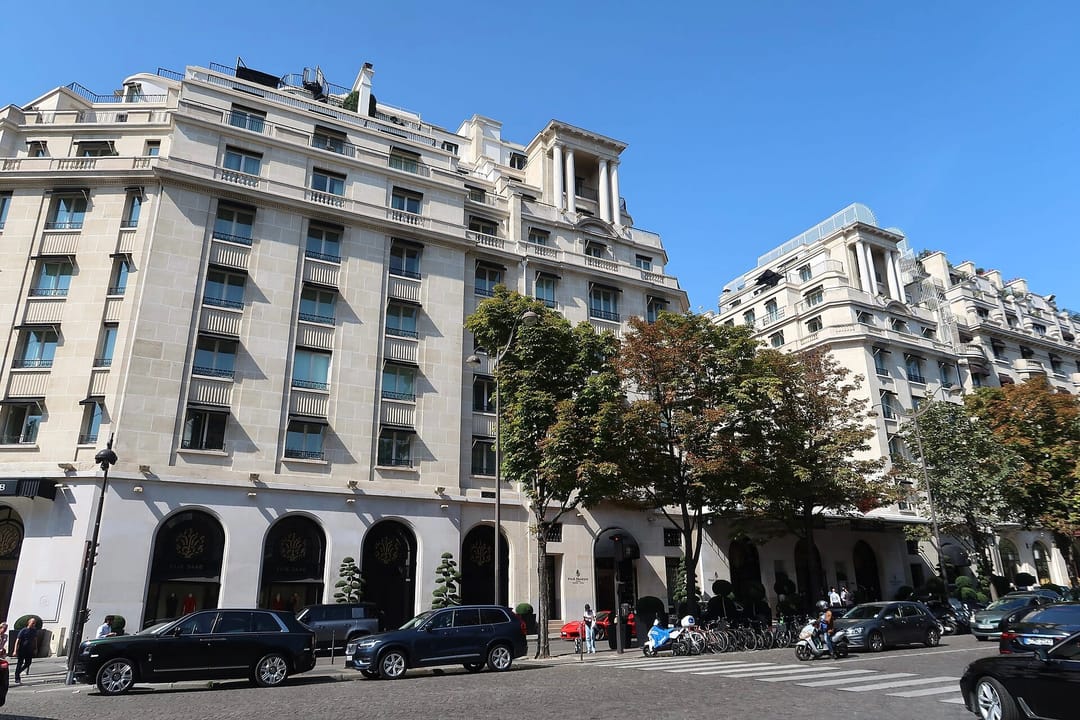
Four Seasons Hotel George V, Paris
Every leg of that 1955 to 1956 grand tour ran through the George V. The family freshened up here on December 21 before the night train to Switzerland, and checked back in on the way home in January to sightsee for three days before taking the Blue Train south to Cannes. The George V remains the most sumptuous of the Paris palaces, the one with the famous flowers, and it wears Joan's brand of polished glamour beautifully.
Avenue George V, Paris. Rooms from around 1,500 euros per night.
La Réserve de Beaulieu
On her 1955 honeymoon with Alfred Steele, Joan stayed at the exquisite La Réserve at Beaulieu-sur-Mer, on the Riviera between Nice and Monaco, and was photographed dining on its Mediterranean terrace. She knew this coast well: back in the early 1930s she and Douglas Fairbanks Jr. had holidayed along the same shore. La Réserve is a Belle Époque jewel of only thirty-nine rooms, and its sea-facing terrace is still set for exactly the sort of lunch Joan liked.
Beaulieu-sur-Mer, France. Rooms from around 400 euros per night.
Paris: The Pepsi Years
Once Joan became Pepsi's globe-trotting first lady, Paris meant honeymoon nights at Maxim's and the whole apparatus of a corporate queen abroad. We follow that itinerary in detail in our Pepsi-years guide.
Paris, France. See the Pepsi-years guide.
Italy
Joan based her June 1955 honeymoon with Al Steele on Capri, was photographed among the marble and gilt of the Excelsior on more than one Roman visit, and sailed home from the Bay of Naples aboard the ill-fated Andrea Doria.
The Westin Excelsior, Rome
The grande dame of the Via Veneto, opened in 1906, the Excelsior was Joan's Rome, and she was photographed among its marble and gilt on more than one Italian visit. Between the Spanish Steps and the Borghese Gardens, it remains one of the capital's most iconic luxury hotels, made for arrivals in dark glasses and a good coat.
Via Vittorio Veneto, Rome. Rooms from around 400 euros per night.
Grand Hotel Quisisana, Capri
On her June 1955 honeymoon with Al Steele, Joan based herself at the Grand Hotel Quisisana in the heart of Capri, the island's grande dame and the traditional harbour for Hollywood stars and the international jet set for well over a century. A few steps from the Piazzetta, it remains a five-star landmark, exactly the sort of address from which a movie star could stroll out to be photographed.
Via Camerelle, Capri. Rooms from around 500 euros per night.
La Canzone del Mare, Capri
By day the honeymooners decamped to La Canzone del Mare, the exclusive bathing club built into the cliffs at Marina Piccola by the English singer Gracie Fields. Joan was famously photographed here, all sunglasses and Capri pants, against the rocks and the sea. The club still serves lunch and cocktails above its saltwater terraces, and it is still the most glamorous place on the island to spend a morning.
Marina Piccola, Capri. Seasonal; day access and dining by reservation.
Naples, Pompeii and the Andrea Doria
The following January the family sailed home from the Bay of Naples aboard the ill-fated Andrea Doria, stopping to see Pompeii on the way. (The Naples leg turned briefly frightening when a crowd grabbed at Joan's jewellery and the family fled to the ship.) The bay and its Roman ruins remain the most cinematic stretch of the Italian south.
Bay of Naples and Pompeii.
Rome and Milan: The Pepsi Years
Joan's Pepsi decade filled Italy with more signature hotels, from the Hassler above the Spanish Steps to the Hotel Principe di Savoia in Milan for the 1961 Giro d'Italia. Both feature in our Pepsi-years guide.
Rome and Milan, Italy. See the Pepsi-years guide.
England
Joan's London went right back to 1932, when she and Douglas Fairbanks Jr. took a late honeymoon in Piccadilly, and it ran all the way to 1969 and her final feature. Through it all, the Savoy on the Strand was her London anchor.
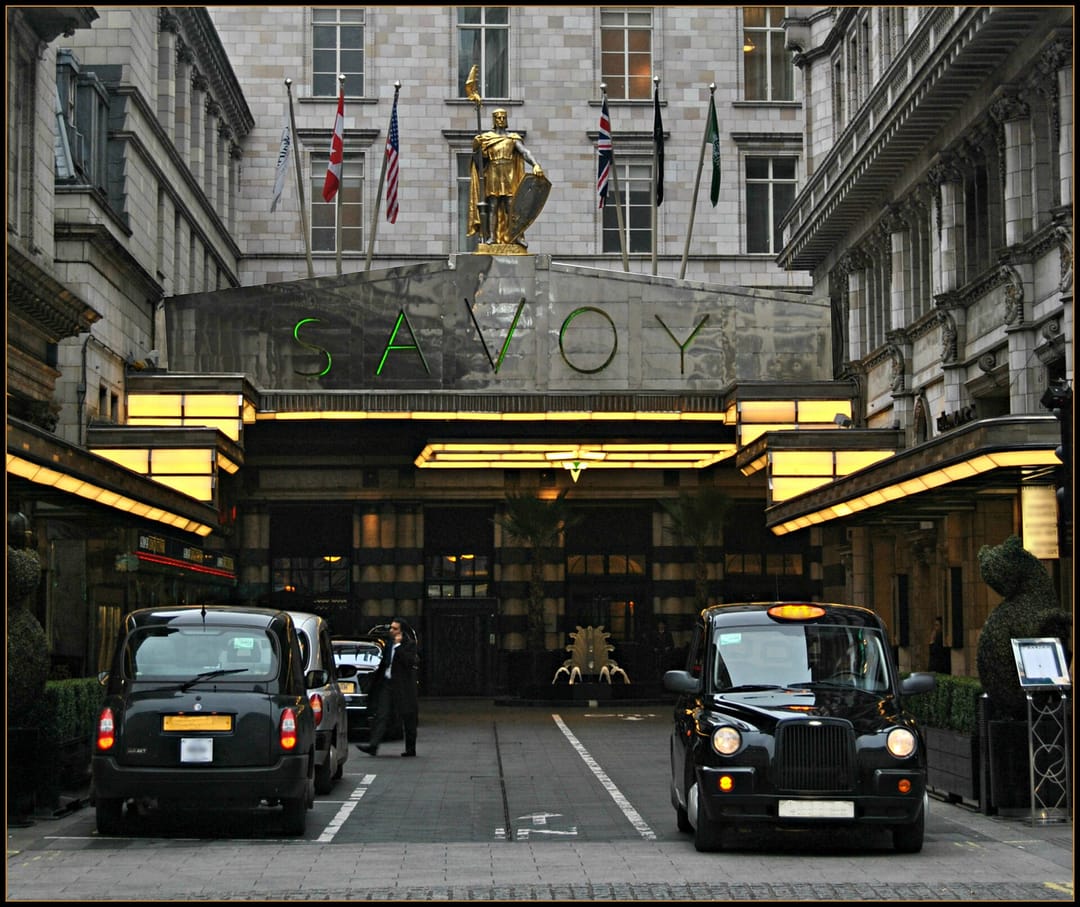
The Savoy, London
The Savoy on the Strand was Joan's London anchor for decades. She held a press conference and reception here during her 1956 trip to film The Story of Esther Costello, and returned in April 1966 as a guest of honour for the Variety Club's International Convention. She loved to pose for photographers on its riverside steps. The Savoy remains the grandest address on the Thames, and still receives its guests with the ceremony Joan expected.
Strand, London. Rooms from around 700 pounds per night.
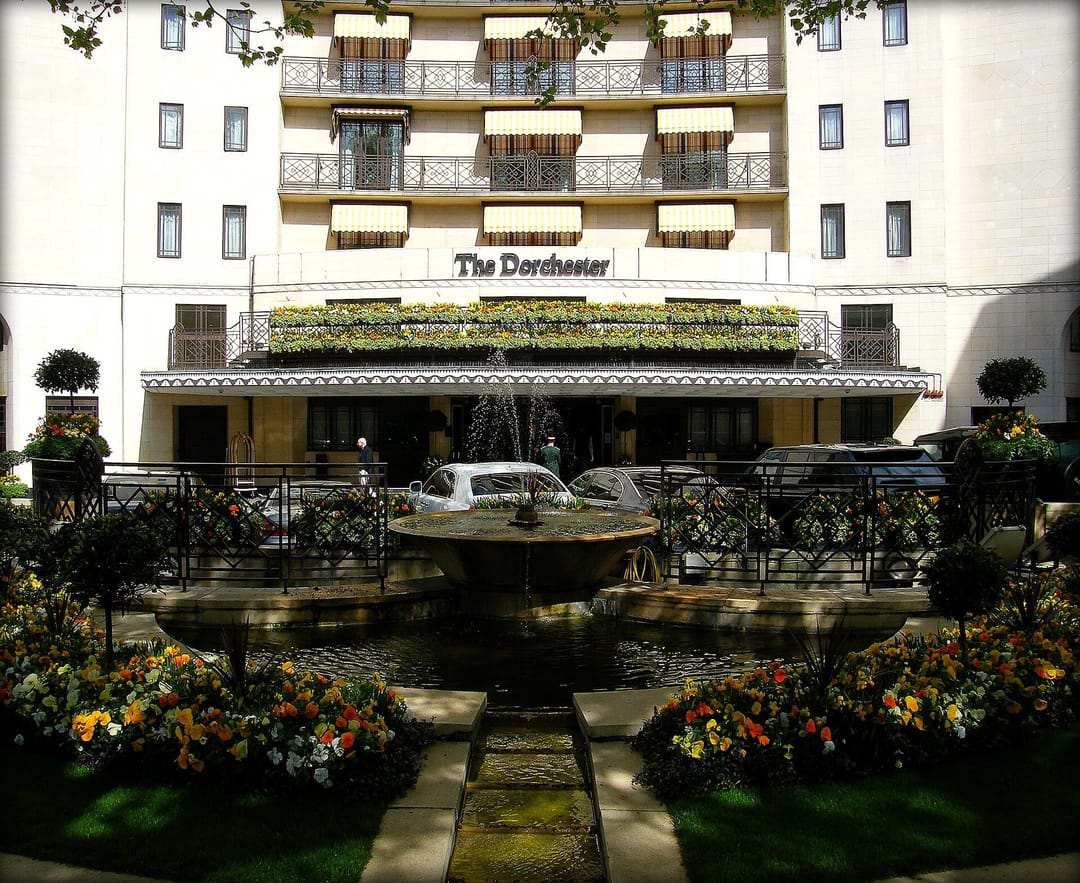
The Dorchester, London
On that same 1956 London trip, photographers caught Joan at the Dorchester on Park Lane having a stray thread bitten off her gown, immaculate to the last stitch, as ever. The Dorchester is still Mayfair's most glamorous hotel, its Promenade the perfect place to be seen taking tea.
Park Lane, London. Rooms from around 750 pounds per night.
Grosvenor House, London
In 1969, arriving to film the horror picture Trog (her final feature), Joan based herself in a suite at Grosvenor House on Park Lane. It was the last of her grand London residencies, and the JW Marriott Grosvenor House still offers the sort of Park Lane suite from which a movie star could commute to a film set in style.
Park Lane, London. Rooms from around 500 pounds per night.
London in the 1930s
Joan's London went right back to 1932, when she and Douglas Fairbanks Jr. took a late honeymoon at the Berkeley in Piccadilly, saw Noël Coward's Cavalcade at Drury Lane, and weekended at Coward's country house. The Berkeley has since moved to Knightsbridge but keeps its between-the-wars glamour intact.
Knightsbridge, London. Rooms from around 600 pounds per night.
Spain
Joan's Spain was a single, characteristically regal appearance: the movie star as visiting dignitary, gracious, photographed and perfectly turned out.
Madrid
Joan came to Madrid on June 2, 1962, as a guest of honour for a film festival, staying at the Hotel Olympic and taking in the full Spanish welcome, bullfight included. It was a characteristically regal Crawford appearance: the movie star as visiting dignitary, gracious, photographed and perfectly turned out.
Madrid, Spain. Pair a visit with the city's grand old hotels around the Gran Vía.
The Middle East
The 1957 Pepsi tour carried Joan through a Middle East that has changed beyond recognition. Some of Joan's road is now a road you travel only in the imagination, which is its own kind of Old Hollywood pilgrimage.
Beirut, Baghdad and Beyond
The 1957 Pepsi tour carried Joan through Beirut, Baghdad, Basra and Cairo, a glamorous, now largely un-followable itinerary through a Middle East that has changed beyond recognition. We cover where you can (and, honestly, cannot) retrace her steps in our Pepsi-years guide.
See the Pepsi-years guide.
Live Like Joan
Dress like Joan
A note on the shoulders. Nobody built a silhouette like Joan Crawford. When designer Adrian widened her shoulders for Letty Lynton in 1932, the look was copied by half a million American women within the year, and Joan wore some version of it, defiantly, for the rest of her life. To dress like Joan is not to dress prettily; it is to dress like a fortress. Strong shoulder, hard lip, and the posture of a woman who has never once slouched into a hotel lobby.
Eat like Joan
For all the caviar at the Palace and the sole at Le Pavillon, Joan cooked, and she cooked with the same precision she brought to everything. The delightful Joan Crawford Cookbook collects her own recipes, and they are a window into her table: a charcoal-broiled steak with Roquefort sauce, poached salmon with a mustard-mayonnaise dressing, roast squab for a dinner party, and, to finish, a Floating Island or Crêpes Suzette. Her hors d'oeuvres ran from the elegant (smoked salmon on pumpernickel) to the frankly startling (peanut butter and bacon canapés). But her most personal ritual was the humble picnic hamper, packed herself and driven up the coast to Carmel. Cook a dish or two from her book, pack the rest into a basket, and eat it somewhere beautiful with a movie star's sense of occasion.
Drink like Joan
Joan's drink was vodka, and she was loyal to it long before the rest of America caught on. She travelled with a personal supply of 100-proof Smirnoff, and once she joined the Pepsi board the pairing wrote itself. Her house pour, the one that fused both halves of her life, could not be simpler.
Joan's Vodka and Pepsi: 60ml (2 oz) good vodka, well chilled; cold Pepsi to top; plenty of ice, a tall glass, a twist of lemon. Build over ice in a highball, top with Pepsi, and stir once. Sip it the way Joan did everything: immaculately turned out, chin up, entirely on duty.
★ ESSENTIAL VIEWING ★
Grand Hotel
1932
Letty Lynton
1932
Mildred Pierce
1945
The Story of Esther Costello
1957
Trog
1970